
An honest view of progress
Working technology. An evolving foundation.
Recon is being built through working software, hardware integration, field testing and research. We distinguish what works today from what is still being developed, tested or explored, and let what we learn shape what comes next.
Build it. Test it. Learn from it.
We develop by putting ideas into working systems and then testing what they actually do. Software behavior, hardware integration, operator workflow and physical validation all matter. When testing exposes a weakness, an assumption or a better direction, the roadmap changes with it.
The goal is not to defend the first design. The goal is to keep improving the system until the evidence supports what we say it can do.
Real hardware. Real signals.
Recon RF is one of the clearest examples of that approach. It combines software with real SDR hardware to observe the spectrum, identify supported signals and decode aviation traffic in real time.
Current development includes hardware discovery, live spectrum observation, signal characterization and native ADS-B and UAT decoding. Broader classification, additional hardware support and direction finding remain active development areas.
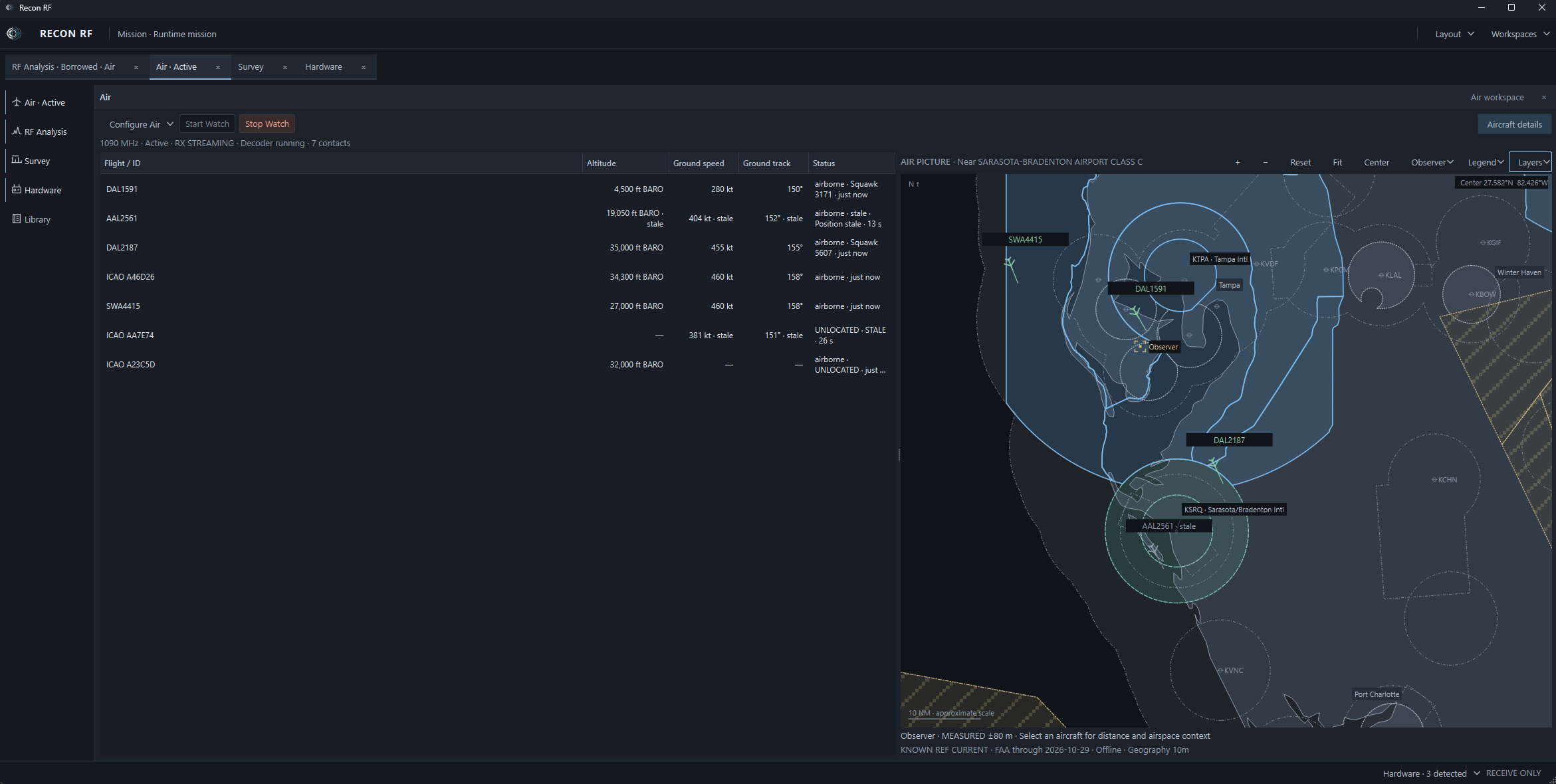
Recon RF Air workspace presenting supported aviation observations and geographic context from live RF reception.
View full-size Air workspace captureSee the signal first.
Recon RF starts at the spectrum. The RF Analysis workspace provides a live view of received activity, supporting investigation of frequency, bandwidth, signal level and observed state before supported signals become higher-level information.
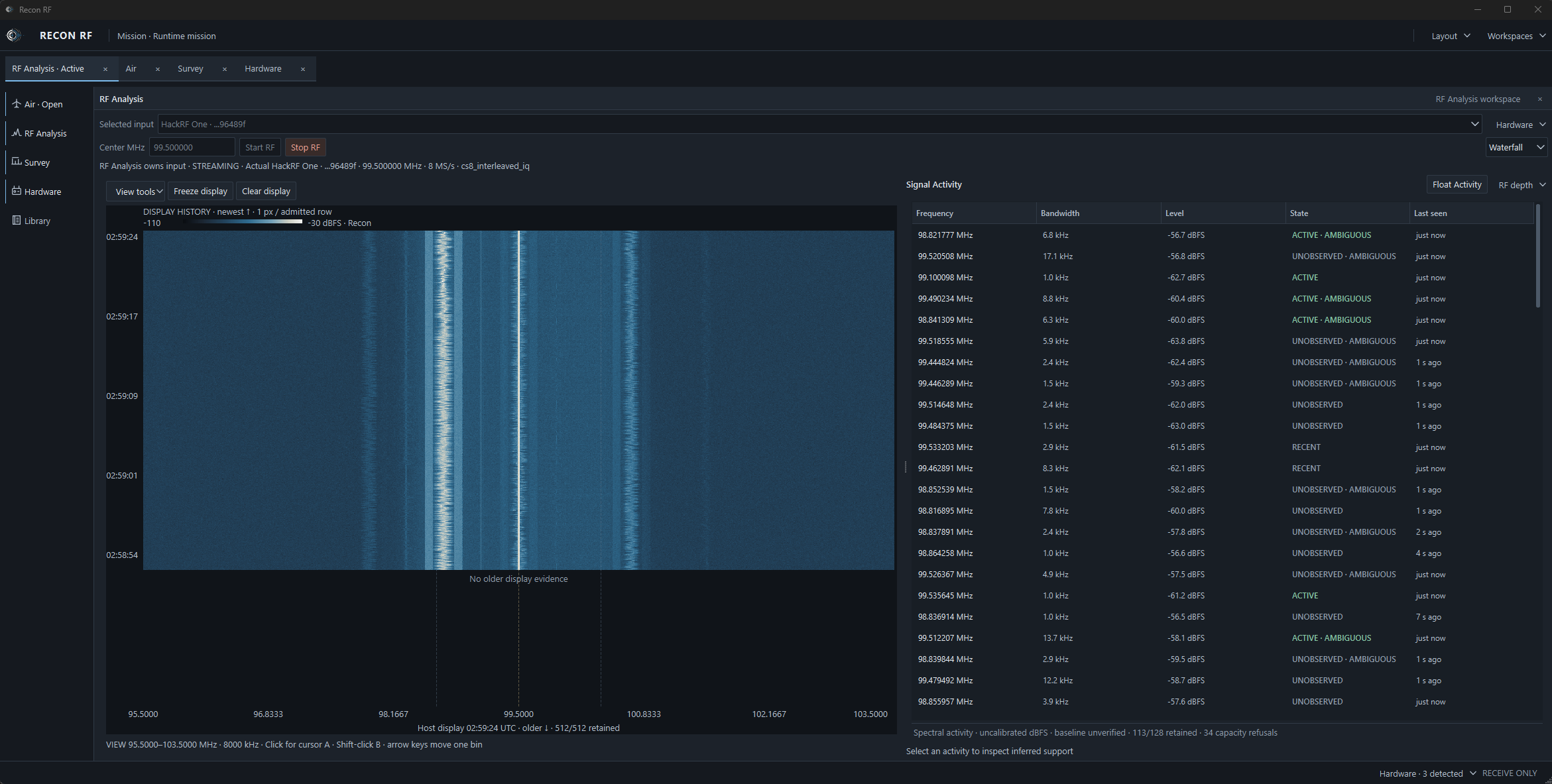
RF Analysis development view showing received spectrum activity and detected signal observations from connected SDR hardware.
View full-size RF Analysis captureDifferent technologies. Different stages.
Recon’s technologies do not all mature at the same pace. Recon RF can be tested directly against hardware and received signals. Janus, Wayfinder, Charon and Argus are developing through software acceptance, integration work, operator workflows and increasingly realistic scenarios.
We track those differences deliberately. A capability that works in software is not automatically described as field validated, and a planned direction is not presented as something that already exists.
Janus
World model & reasoning
Working foundations for observations, entities, relationships, provenance, uncertainty and operational state. Reasoning and decision-support capability continue to expand.
Wayfinder
Acquisition, normalization & provenance
Working ingestion and source-lifecycle foundations for supported aviation, maritime, mobile, environmental and weather observations, with additional adapters continuing to develop.
Charon
Transport & governed interchange
Working deterministic foundations for validation, policy, journaling, idempotency, bounded retry, quarantine and replay. External transport and deployment assurance remain development work.
Argus
3D visualization & interaction
Working visualization and operator-interaction foundations for exploring Janus world state, supported tracks, environmental layers and evidence.
Recon RF
Spectrum awareness
Working hardware-aware spectrum observation with native ADS-B and UAT software decoding. Broader classification, hardware support and direction finding continue in development.
Evidence changes the roadmap.
Development is iterative by design. Testing can confirm an approach, expose a limitation or show that a different solution is better. We document those results, preserve the decisions that matter and keep moving forward from what the evidence supports.
That applies to software, hardware and research alike. Progress is not measured by protecting an original idea. It is measured by making the system more useful, more understandable and more reliable.
Useful beats impressive.
A system can be technically advanced and still fail if people will not use it under real conditions. Operator workflow, cognitive load, connectivity, hardware constraints and environmental conditions are part of the engineering problem.
We design with the person using the technology in mind first, then build the broader operating picture around the information they can realistically provide and consume.
Keep building.
Recon is still evolving. The foundations are working, the portfolio is taking shape and the next steps are driven by testing, integration and what we continue to learn.
Explore the technology